
Long-term monitoring of Ziphius cavirostris behavior using 3D tracking from fixed hydrophone arrays off Southern California.
Scientific Reports. 2025.
15: 40859 (2025)
More details
Collapse details
Date Published:
- November 19, 2025
Vessel strike encounter risk model informs mortality risk for endangered North Atlantic right whales along the United States east coast.
Scientific Reports. 2025.
736 (2025). https://doi.org/10.1038/s41598-024-84886-z
More details
Collapse details
Date Published:
- January 3, 2025
Long-term passive acoustic recordings track the changing distribution of North Atlantic right whales (Eubalaena glacialis) from 2004 to 2014.
Scientific Reports. 2017.
7:13460
More details
Collapse details
Date Published:
- October 18, 2017
More details
Collapse details
Date Published:
Publication:Ocean:Region:Methods:
- May 13, 2025
Passive acoustic monitoring (PAM) is a key technology for studying marine mammal populations. PAM typically generates large volumes of data that contain signals from multiple overlapping sources. To extract meaningful information from these data, automated tools are required that can cope with multiple sources, missed detections, and false alarms. This paper presents the Multiple-Animal Model-Based Acoustic Tracking (MAMBAT) framework, which integrates model-based localization with Bayesian multi-target tracking to automatically track multiple sound sources using acoustic data from wide baseline arrays. MAMBAT leverages a “Track-before-Localize” strategy followed by a “Localize-then-Track” strategy that does not require detection, classification, or association steps. The framework’s effectiveness is demonstrated through application to real-world datasets that contain multiple sperm whales from two ocean basins. MAMBAT advances our ability to monitor marine mammal distribution, abundance, and behavior, with potential to provide valuable information for conservation and management efforts.
Hidden Markov models reveal complexity in the diving behaviour of short-finned pilot whales.
Scientific Reports. 2017.
7:45765
More details
Collapse details
Date Published:
Publication:Ocean:Region:Species:Methods:
- March 31, 2017
Diving behaviour of short-finned pilot whales is often described by two states; deep foraging and shallow, non-foraging dives. However, this simple classification system ignores much of the variation that occurs during subsurface periods. We used multi-state hidden Markov models (HMM) to characterize states of diving behaviour and the transitions between states in short-finned pilot whales. We used three parameters (number of buzzes, maximum dive depth and duration) measured in 259 dives by digital acoustic recording tags (DTAGs) deployed on 20 individual whales off Cape Hatteras, North Carolina, USA. The HMM identified a four-state model as the best descriptor of diving behaviour. The state-dependent distributions for the diving parameters showed variation between states, indicative of different diving behaviours. Transition probabilities were considerably higher for state persistence than state switching, indicating that dive types occurred in bouts. Our results indicate that subsurface behaviour in short-finned pilot whales is more complex than a simple dichotomy of deep and shallow diving states, and labelling all subsurface behaviour as deep dives or shallow dives discounts a significant amount of important variation. We discuss potential drivers of these patterns, including variation in foraging success, prey availability and selection, bathymetry, physiological constraints and socially mediated behaviour.
Complete
Acoustic and Visual Survey for Cetaceans in Behm Canal and Southern Clarence Strait, Alaska
Project Objectives
Conduct visual line-transect surveys and passive acoustic monitoring for cetaceans, and other marine mammals, to determine species occurrence, and to estimate density within Navy’s testing range. Acoustic monitoring devices will be deployed during the vessel based survey, and long-term passive acoustic hydrophones will be monitored for year-round detection of rare and/or cryptic cetacean species.
Complete
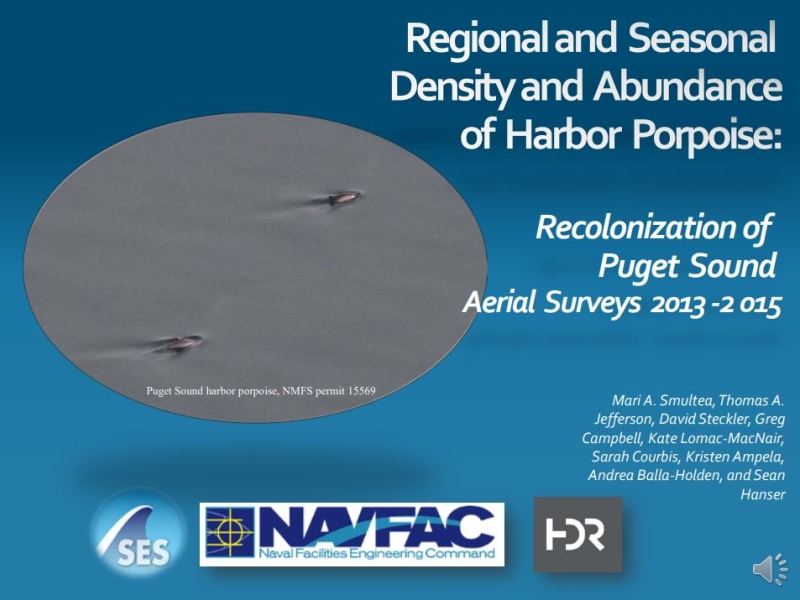
Aerial Surveys of Marine Mammals Conducted in the Inland Puget Sound Waters of Washington, summer 2013 – winter 2016
Project Objectives
1) Conduct aerial surveys during four seasonal periods within the inland Puget Sound Survey Area to assess potential differences in seasonal distribution, numbers, and behavioral state patterns of marine mammals; 2) Collect data to estimate densities of marine mammals in the inland Puget Sound waters for species with sufficient sightings; 3) Estimate abundance for each marine mammal species seen an adequate number of times; 4) Document the distribution and habitat use of each species observed; 5) Document and describe behaviors seen without performing focal follows.
Current
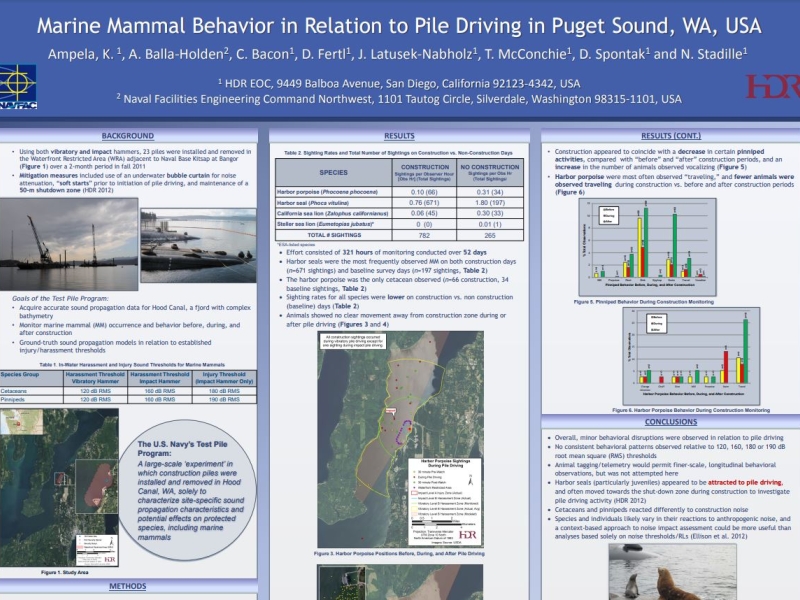
Monitoring Cetaceans in Hood Canal
Project Objectives
This 12‑month integrated pilot project combines three complementary components: (A) shore‑based theodolite monitoring of harbor porpoises, (B) high‑bandwidth passive acoustic monitoring and soundscape characterization, and (C) suction‑cup multi‑sensor tag deployments on Bigg’s (transient) killer whales. Together, these data streams will quantify occurrence, movement, diving, and behavioral context for these two key species in relation to the local soundscape—including operational signals near the Dabob Bay Range Complex (DBRC) and the Bangor Trident Base. Results can provide an empirical foundation and inform the study design of future cetacean behavioral response studies (BRS) in Hood Canal.
Complete
Occurrence, Distribution, and Density of Marine Mammals Near Naval Station Norfolk and Virginia Beach
Project Objectives
Assess occurrence, seasonality, and abundance of Tursiops in the coastal waters of Hampton Roads military installations
Current
Pacific Marine Assessment Program for Protected Species (PACMAPPS) survey
Project Objectives
Identify species of beaked whales, odontocetes, and baleen whales that occur in the surveyed areas; Monitor marine mammal and sea turtle presence, distribution, and diversity in offshore waters; Develop a better understanding of marine mammal distribution, movement patterns, habitat use, population structure, and abundance; Develop reference library of visually-validated acoustic recordings of marine mammals.
Current
Passive Acoustic Monitoring of Harbor Porpoises in Hood Canal
Project Objectives
This project was jointly funded through NAVSEA and the NUWC Keyport NISE program to address the Navy’s need for multi-year data on harbor porpoise occurrence and spatiotemporal distribution patterns in Hood Canal using passive acoustic monitoring (PAM).
Complete
Vessel-based Marine Mammal Surveys in Puget Sound, Washington
Project Objectives
Conduct marine mammal in-water vessel-based line transect surveys in the Puget Sound basin to: 1) Record data on all marine mammal species seen with the study area, with a focus on the killer whale (Orcinus orca) and the harbor porpoise (Phocoena phocoena). 2) Identify the seasonal occurrence and abundance/density of cetaceans within the study area. 3) Identify the effects of environmental variables on the distribution and abundance of species in the study area.No related blog posts to display